
Ayn Rand
Ayn Rand
Ayn Rand “The Fountainhead” Signed First UK Edition - 1947
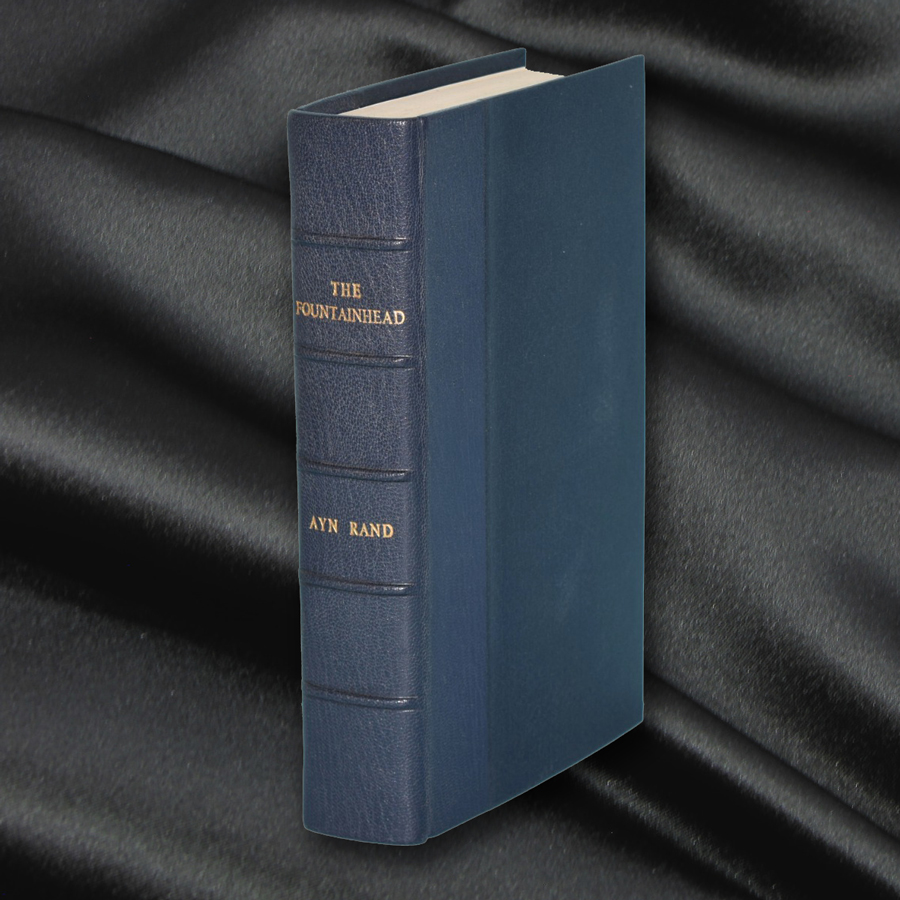
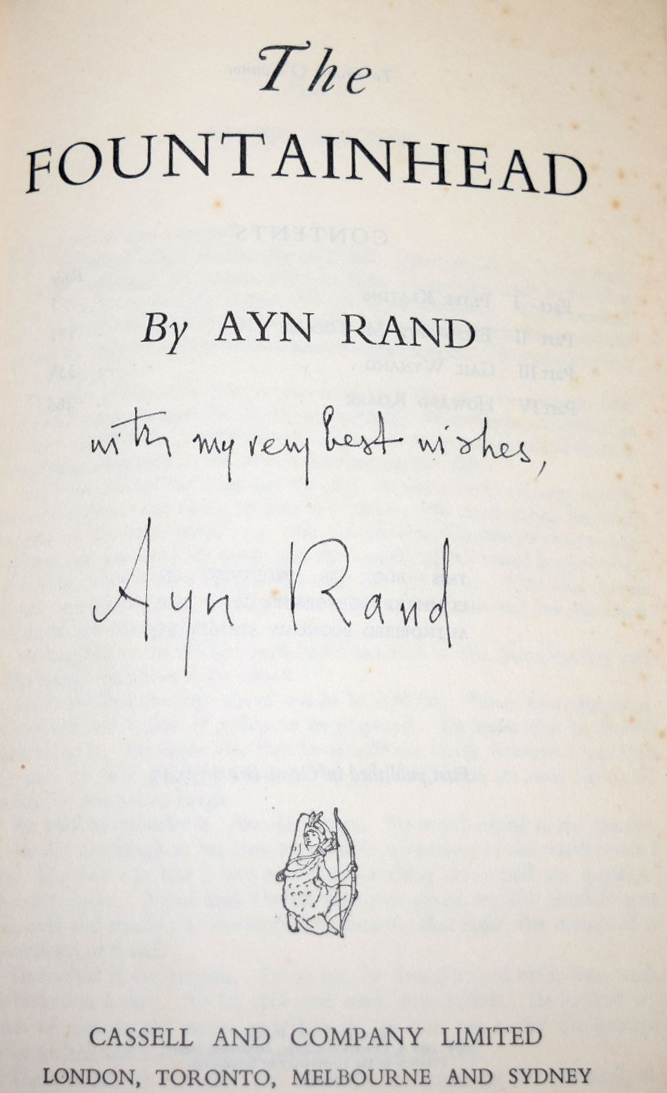

Ayn Rand — The Fountainhead — Signed First British Edition, 1947 — Fine Harcourt Bindery Full Morocco
Ayn Rand (1905–1982)
The Fountainhead
London: Cassell and Company, 1947
First British Edition
Boldly Signed by Ayn Rand
An exceptional signed first British edition of Ayn Rand’s landmark novel The Fountainhead, the book that transformed Rand from a relatively little-known novelist and playwright into one of the most influential—and controversial—literary and philosophical voices of the twentieth century.
Published by Cassell in London in 1947, four years after the American first edition, this handsome octavo has been exquisitely rebound by the Harcourt Bindery in full morocco leather, with gilt titles and elaborate gilt tooling to the spine in six compartments separated by raised gilt bands. Gilt ruling frames the front and rear boards, with gilt inner dentelles, marbled endpapers, and all edges gilt. The binding is stamp-signed by the Harcourt Bindery.
Most importantly, the volume is boldly signed by the author: “All my best wishes / Ayn Rand”
The book is in fine condition, presenting beautifully as both a significant literary first edition and an unusually luxurious example of the bookbinder’s art.
The Novel That Made Ayn Rand Famous
Born Alisa Zinovyevna Rosenbaum in St. Petersburg, Russia, in 1905, Ayn Rand experienced the upheaval of the Russian Revolution before emigrating to the United States in 1926. Settling eventually in Hollywood, she worked as a screenwriter and pursued fiction while developing the ideas concerning individualism, reason, achievement, and personal liberty that would later form the basis of her philosophy of Objectivism.
Before The Fountainhead, Rand had published We the Living and achieved theatrical success with Night of January 16th. Her great breakthrough, however, proved remarkably difficult to bring into print.
Rand began developing what became The Fountainhead in the 1930s, originally working under the title Second-Hand Lives. Publishers repeatedly rejected the manuscript, some considering it too intellectual or commercially uncertain. Rand eventually dismissed her literary agent and began handling submissions herself.
The novel finally found a champion at Bobbs-Merrill in editor Archibald Ogden, who strongly defended the manuscript when others at the publishing house wanted to reject it. Rand received a $1,000 advance and completed the enormous manuscript at the end of 1942.
Published in the United States in 1943, The Fountainhead initially sold slowly. Word of mouth changed its fortunes dramatically. Within two years it had become a bestseller, eventually reaching No. 6 on The New York Times bestseller list and establishing Rand as a major American novelist.
Its protagonist, Howard Roark, is an uncompromising young architect determined to create according to his own judgment rather than surrender his artistic vision to convention, fashion, or public approval. Through Roark’s struggle, Rand explored the conflict between the independent creator and the forces demanding conformity—a theme that would become central to virtually everything she subsequently wrote.
Rand herself characterized the novel’s essential conflict as one of individualism versus collectivism, played out not simply in politics but within the individual human spirit.
The book’s success led Warner Bros. to produce the celebrated 1949 film adaptation starring Gary Cooper as Howard Roark and Patricia Neal as Dominique Francon, with Rand herself writing the screenplay.
Rand followed The Fountainhead with her monumental 1957 novel Atlas Shrugged, after which she increasingly devoted herself to philosophical writing and public lectures. Her advocacy of reason, individual rights, capitalism, and what she termed “rational self-interest” made her one of the most debated intellectual figures of the postwar era.
Whatever one’s view of her philosophy, Rand’s cultural influence is undeniable. The Fountainhead has remained continuously influential for generations of readers, particularly among entrepreneurs, artists, architects, writers, and others drawn to its defense of creative independence.
A Distinguished Collector’s Copy
Signed copies of The Fountainhead are highly desirable in the modern first-edition market. This example is especially striking: a first British edition published by Cassell in 1947, boldly signed by Rand and transformed into an elegant presentation volume through its finely executed Harcourt Bindery full-morocco binding.
With its raised gilt bands, elaborate gilt decoration, marbled endpapers, gilt dentelles, and all edges gilt, it is a handsome shelf presence worthy of one of the defining literary works of twentieth-century individualism.
Edition: First British Edition
Publisher: Cassell and Company, London
Publication Date: 1947
Binding: Full Morocco by the Harcourt Bindery
Signed: Boldly inscribed and signed by Ayn Rand
Condition: Fine
Features: Raised gilt bands; gilt spine titles and tooling; gilt board ruling; gilt inner dentelles; marbled endpapers; all edges gilt
A superb signed example of the novel that established Ayn Rand’s reputation and introduced Howard Roark—one of the twentieth century’s most recognizable literary embodiments of uncompromising individualism.