
Albert Einstein
Albert Einstein
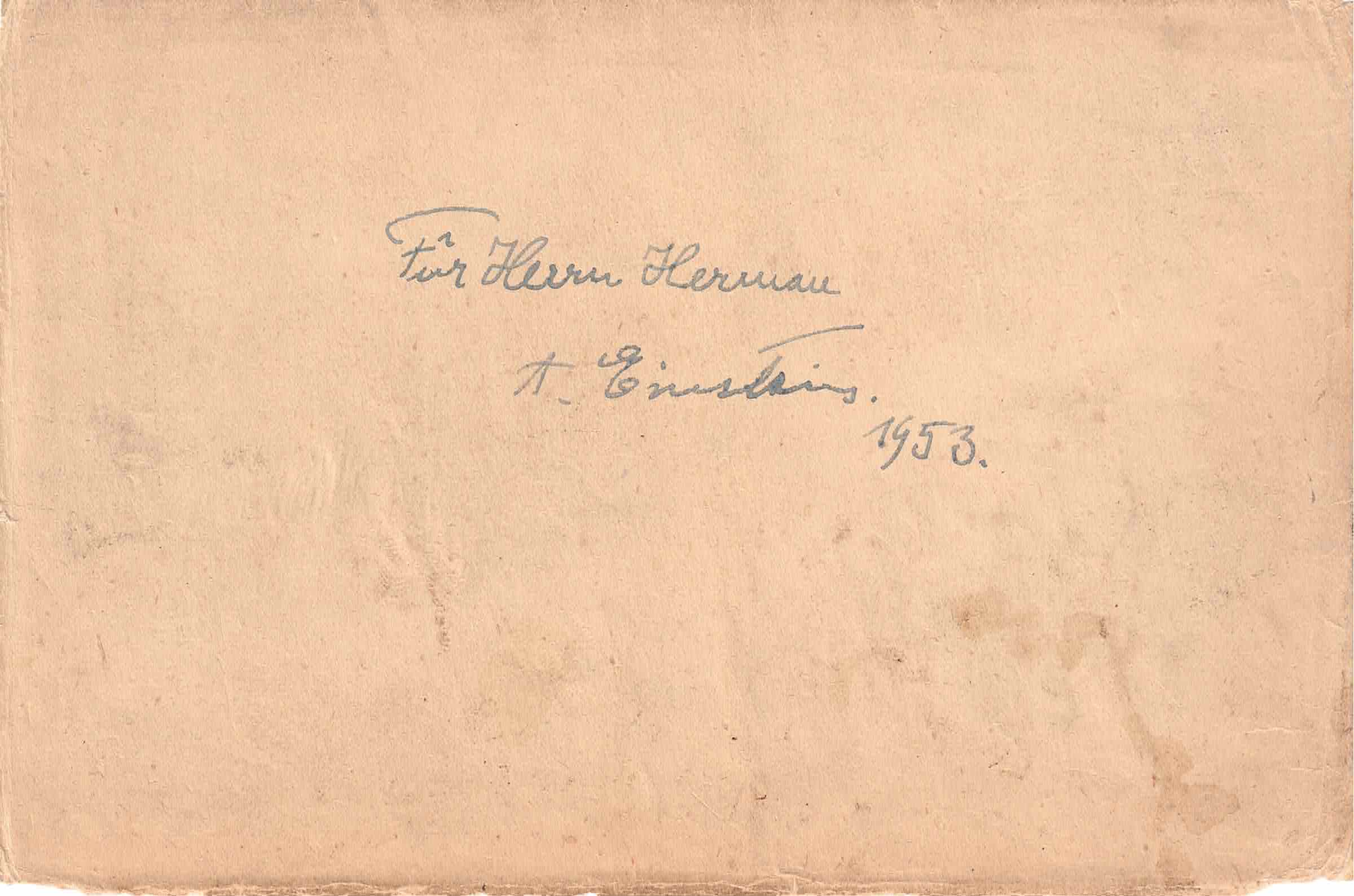
Albert Einstein — Inscribed and Signed Presentation Leaf - 1953
Albert Einstein (1879–1955)
Handwritten presentation inscription signed “A. Einstein”
Dated 1953
Inscribed in German: “Für Herrn Hermann”
A compelling late-life autograph of Albert Einstein, one of the defining scientific figures of the twentieth century, personally inscribed and signed in 1953.
Einstein writes:
Für Herrn Hermann
A. Einstein
1953
Translated:
For Mr. Hermann
A. Einstein
1953
The inscription is executed in a fluid mature hand, with the compact, abbreviated form of Einstein’s signature characteristic of his later years. The ink shows natural variation in density and penetration into the paper fibers, consistent with handwritten ink rather than an obvious printed facsimile.
Einstein in 1953
By 1953, Einstein was seventy-four years old and living in Princeton, New Jersey, where he remained associated with the Institute for Advanced Study. Nearly half a century had passed since his revolutionary 1905 papers on relativity, Brownian motion, and the photoelectric effect, yet Einstein remained an internationally recognized public intellectual and one of the most famous scientists alive.
His scientific reputation had long since been secured. He had received the 1921 Nobel Prize in Physics, principally for his explanation of the photoelectric effect, and his theories of special and general relativity had fundamentally altered modern conceptions of space, time, gravity, and energy.
During his later Princeton years, Einstein continued working toward a unified field theory while corresponding widely on scientific, philosophical, humanitarian, and political matters.
The Recipient: “Herr Hermann”
The inscription is addressed simply to “Herrn Hermann” — “Mr. Hermann.”
The recipient has not yet been conclusively identified.
One historically intriguing possibility is Hermann Weyl (1885–1955), the eminent German mathematician and physicist who had a long personal and professional association with Einstein. Weyl made major contributions to the mathematical foundations of relativity, corresponded with Einstein, and, like Einstein, was associated with the Institute for Advanced Study at Princeton during this period.
However, without independent provenance tying the object directly to Weyl, the recipient should presently be described only as “Herr Hermann,” identity unknown.
That distinction is important, and the item should not be represented as having belonged to Hermann Weyl unless documentary evidence emerges.
Autograph Characteristics
Close examination of the inscription shows several features consistent with genuine handwritten ink:
- variable line width and pen pressure;
- darker ink accumulation at turns and stroke intersections;
- irregular penetration of ink into the paper fibers;
- natural edge feathering;
- spontaneous-looking letter formation;
- no visible halftone, toner, or inkjet reproduction pattern;
- a fluid, compressed “A. Einstein” signature consistent in general form with Einstein’s late-period autograph style.
These observations support the conclusion that the inscription is handwritten rather than mechanically reproduced.
They do not, by themselves, constitute third-party authentication of Einstein’s authorship. Professional authentication by PSA/DNA, JSA, Beckett, or another recognized autograph authority would materially strengthen both attribution and value.
About Albert Einstein
Born in Ulm, Germany, in 1879, Einstein transformed modern physics through theories that challenged the Newtonian understanding of the universe.
His 1905 theory of special relativity introduced the relationship between mass and energy famously expressed as:
E = mc²
A decade later, his general theory of relativity described gravity not simply as a force but as the curvature of spacetime produced by mass and energy.
The spectacular confirmation of Einstein’s prediction concerning the bending of starlight during the 1919 solar eclipse made him an international celebrity virtually overnight.
Einstein emigrated permanently to the United States after Adolf Hitler came to power in 1933. He joined the Institute for Advanced Study in Princeton and remained there for the rest of his life.
Beyond physics, Einstein became an outspoken advocate for civil liberties, Jewish causes, international cooperation, nuclear disarmament, and intellectual freedom.
He died in Princeton on April 18, 1955, only two years after this inscription was written.
Condition
The sheet shows expected age toning and handling consistent with a mid-twentieth-century paper artifact. The inscription remains clear and legible, with strong contrast between ink and paper.
Collector Significance
Einstein remains one of the most desirable names in twentieth-century scientific autograph collecting.
This example has several appealing features:
dated 1953, placing it within Einstein’s final years;
personally inscribed rather than merely signed;
written in German, Einstein’s native language;
and bearing the familiar abbreviated “A. Einstein” signature.
A visually engaging and historically evocative Einstein presentation inscription from the closing years of one of the most consequential scientific lives in modern history.
Date: 1953
Language: German
Inscription: “Für Herrn Hermann”
Signature: “A. Einstein”
Medium: Ink on paper