
H.G. Wells
H.G. Wells
H. G. Wells Autograph Letter Signed Discussing Abinger Common and a Recent Visit - 1930
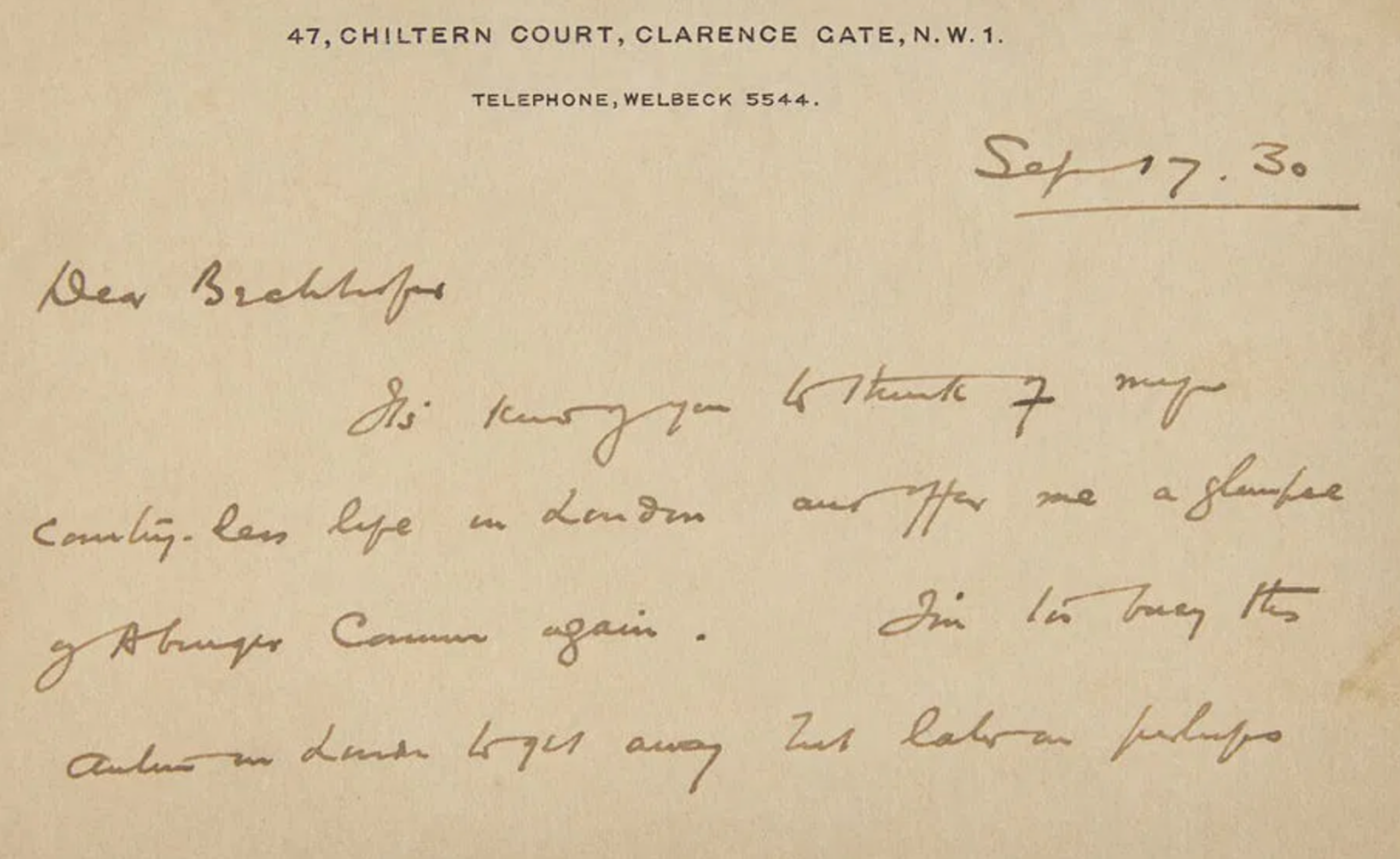
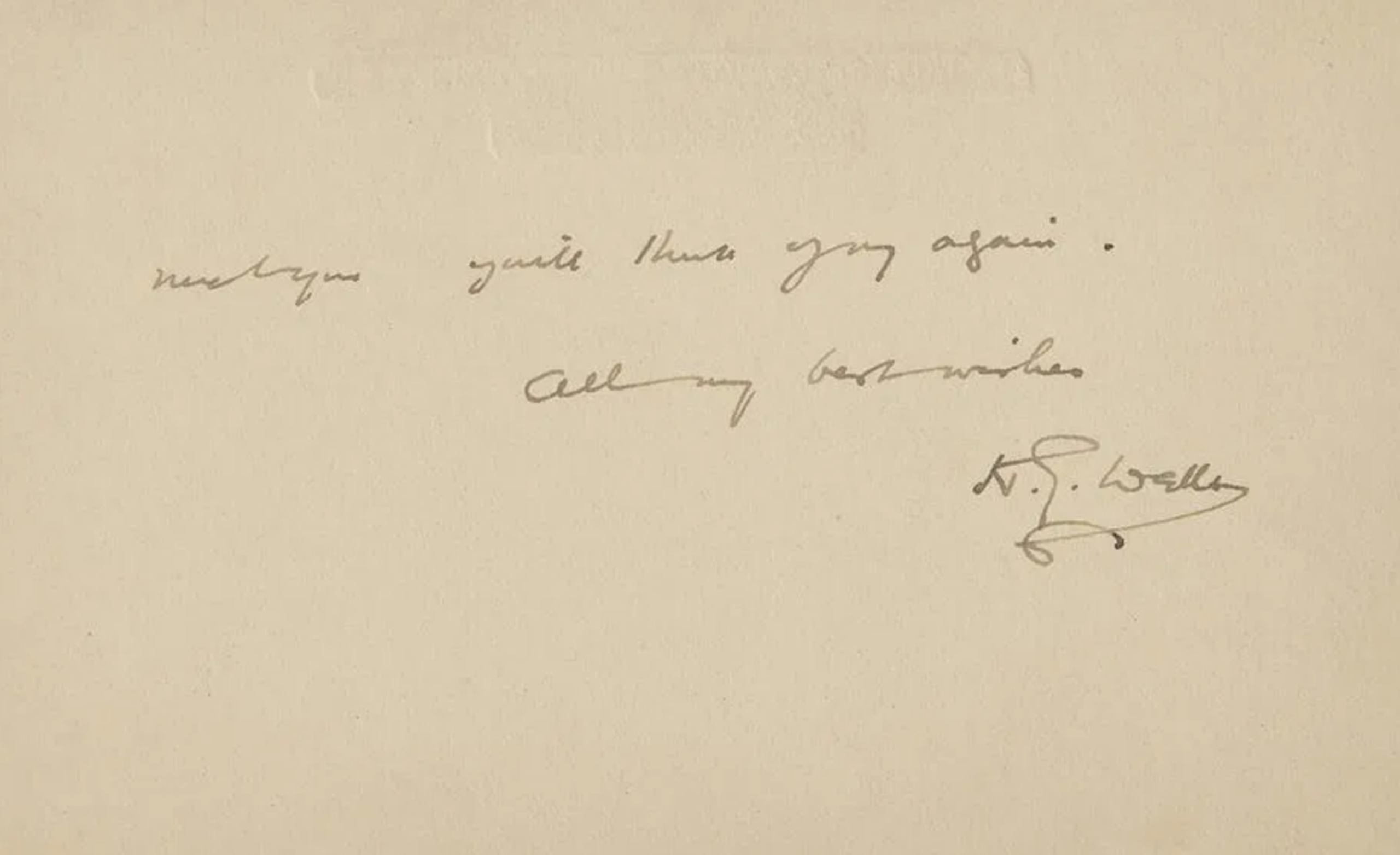
H. G. Wells (1866–1946)
Autograph Letter Signed, “H. G. Wells”
September 17, 1930
47 Chiltern Court, Clarence Gate, London
Two handwritten pages on Wells’s personal stationery
An appealing personal autograph letter by H. G. Wells, pioneering author of The Time Machine, The War of the Worlds, The Invisible Man, and The Island of Doctor Moreau, written from his London residence on September 17, 1930.
Writing on his distinctive 47 Chiltern Court, Clarence Gate, N.W.1. stationery, Wells thanks his correspondent—apparently writer and journalist C. E. Bechhofer Roberts—for his company during a recent London visit and expresses the hope of seeing him again.
The letter also makes reference to Abinger Common, the picturesque Surrey village with notable literary associations, including E. M. Forster, who lived nearby at Abinger Hammer.
Wells writes warmly and informally, closing:
“All my best wishes, H. G. Wells.”
H. G. Wells and the Birth of Modern Science Fiction
Herbert George Wells was born in Bromley, Kent, in 1866. Trained in biology under Thomas Henry Huxley, Wells combined a fascination with science and technological progress with an equally strong interest in social organization and humanity’s future.
His extraordinary sequence of scientific romances during the 1890s established many of the conventions of modern science fiction.
The Time Machine introduced readers to mechanical time travel; The Island of Doctor Moreau explored biological experimentation; The Invisible Man considered the consequences of invisibility; and The War of the Worlds created one of literature’s defining stories of extraterrestrial invasion.
Yet Wells’s interests extended considerably beyond speculative fiction. He wrote novels, histories, essays, political works and social commentary throughout a career spanning more than half a century. His enormously successful The Outline of History brought world history to a mass readership, while his political writings advocated internationalism and what he hoped would eventually become a rationally organized world society.
Wells in 1930
The letter dates from an interesting transitional period in Wells’s life.
In 1930, Wells established himself at 47 Chiltern Court, an imposing Art Deco apartment building near Baker Street in London. The address became one of his principal residences during the first half of the 1930s. Other surviving Wells correspondence from the period confirms his use of this stationery and address.
At sixty-four, Wells was already an internationally celebrated literary figure. His great scientific romances were decades behind him, but he remained intensely productive and deeply engaged in contemporary intellectual and political affairs.
This letter captures the private Wells rather than the public polemicist: making social arrangements, thanking a friend for his companionship, and hoping that circumstances would bring them together again.
Collector Significance
Autograph letters by Wells remain desirable artifacts of one of the foundational figures of modern speculative literature. This example benefits from being entirely handwritten, dated, written on identifiable personal stationery, and signed with Wells’s full “H. G. Wells” signature.
The letter is also an attractive display piece, with Wells’s printed London address prominently displayed across the top of the first page.
Author: H. G. Wells
Date: September 17, 1930
Place: London, England
Address: 47 Chiltern Court, Clarence Gate, N.W.1.
Format: Autograph Letter Signed (ALS)
Length: Two handwritten pages
Signature: “H. G. Wells”
Recipient: Apparently C. E. Bechhofer Roberts
Condition: Very good, with expected light toning and handling consistent with age.
An attractive and personal handwritten letter from H. G. Wells, one of the most influential writers in the history of science fiction.
Transcription
47, Chiltern Court, Clarence Gate, N.W.1.
Telephone, Welbeck 5544.
Sept 17. 30
Dear Bechhofer,
It’s kind of you to think of my
country-less life in London and offer me a glimpse
of Abinger Common again. I’m too busy this
autumn in London to get away but London perhaps
may give you until then going again.
All my best wishes
H. G. Wells