
Henri Jules de Bourbon
Henri Jules de Bourbon
Henri Jules de Bourbon Manuscript Document Signed
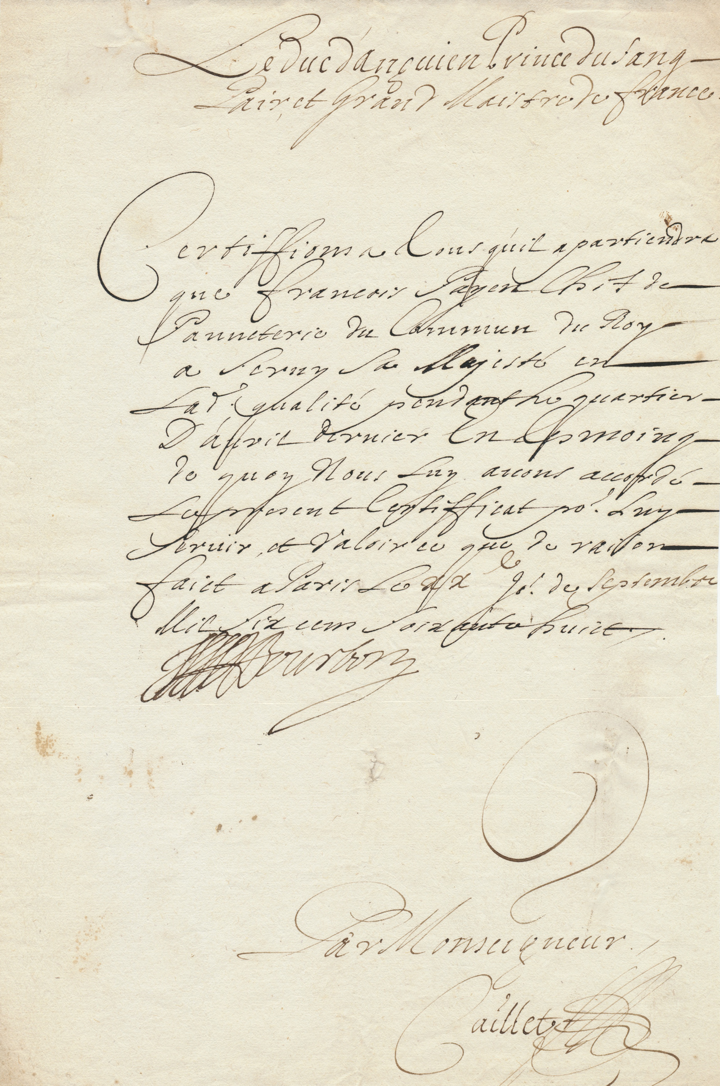
1680 French Royal Household Certificate Signed Under the Duc d’Enghien, Prince of the Blood
Official certificate of service for François Robert, Pannetier du Commun du Roi
Paris, 2 September 1680
Henri-Jules de Bourbon, Duc d’Enghien / future Prince de Condé
An elegant seventeenth-century French manuscript certificate issued at Paris under the authority of Henri-Jules de Bourbon, then Duc d’Enghien, Prince of the Blood, Premier Pair, and Grand Maître de France. The document certifies the royal household service of François Robert, identified as Pannetier du Commun du Roi, an officer connected with the bread service and provisioning of the King’s household.
Dated 2 September 1680, the certificate attests that Robert served His Majesty in this office for a quarter-year beginning the previous April. Such documents functioned as formal proofs of service, used to establish employment, standing, compensation, or future claims within the highly structured world of the French royal household.
The title Prince du Sang placed Henri-Jules among the highest-ranking nobles of France, part of the Bourbon bloodline and close to the royal family itself. As heir to the powerful Condé line, he occupied a privileged position in the courtly hierarchy of Louis XIV’s France, where even administrative certificates reflected the elaborate machinery of royal service.
The office of Pannetier du Commun du Roi should not be understood merely as that of a baker. In the ancien régime household, the bread service formed part of the ceremonial and logistical structure of the royal table. Officers attached to these departments held recognized posts within the Maison du Roi, and certificates such as this provided formal recognition of service rendered.
French Transcription
Le Duc d’Enghien, Prince du Sang, Premier Pair et Maître de France.
Certifions à ceux qu’il appartiendra que François Robert,
fils de [nom incertain], Pannetier du Commun du Roy,
a servi Sa Majesté en ladite qualité pendant un quartier
d’avril dernier en ce mois, de quoy nous luy avons accordé
le présent certificat pour luy servir et valoir ce que de raison.Fait à Paris ce 2e jour de Septembre
mil six cens quatre vingt.[Signature]
English Translation
The Duke of Enghien, Prince of the Blood, First Peer and Master of France.
We certify to all whom it may concern that François Robert,
son of [name uncertain], Pannetier du Commun du Roi,
served His Majesty in the said capacity during a quarter-year
from last April until this month, for which we have granted him
the present certificate, so that it may serve and avail him
wherever lawful proof may be required.Done at Paris this 2nd day of September,
one thousand six hundred and eighty.
Condition
Manuscript ink on laid paper, with expected age toning, light foxing, handling wear, and folds consistent with seventeenth-century administrative use. The handwriting remains substantially legible, with attractive period flourishes and a prominent signature, 1p, 7-¾ ” x 11-¾.”
Historical Importance
This certificate offers a direct glimpse into the administrative life of the Maison du Roi under Louis XIV. While brief, it connects the daily machinery of royal service with one of the greatest noble houses of France, the Condés. Documents bearing the authority of a Prince of the Blood are far more historically compelling than ordinary court memoranda, particularly when tied to named service within the King’s household.

Henri Jules de Bourbon, Prince of Condé (1643-1709) was prince de Condé, from 1686 to his death. Henri Jules was born to Louis II de Bourbon, Prince de Condé and his wife in 1643. He was five years younger than King Louis XIV. An only child, he became the sole heir to the enormous Condé fortune and property. His mother was a niece of Cardinal Richelieu. Throughout much of his life, Henri Jules was mentally unstable. It was said that his mental illness was inherited through his mother’s family. He was a debauched and brutal man not only “repulsive in appearance”, but “cursed with so violent a temper that it was positively dangerous to contradict him”.
Trained as a soldier, in 1673, he was put in charge of the Rhine front. This high-ranking military position was just in name only though, because Henri Jules lacked the military skills of his father. He eventually married Anne Henriette of Bavaria in the chapel of the Palais du Louvre, in Paris, in December 1663. At the end of his life Henri Jules suffered from clinical lycanthropy, a rare psychiatric syndrome that involves a delusion that the affected person can or has transformed into a wolf—with correspondingly altered behavior.