
Sitting Bull
Sitting Bull
Sitting Bull & Buffalo Bill Cody — Two Historic Cabinet Photographs, 1882 & 1885
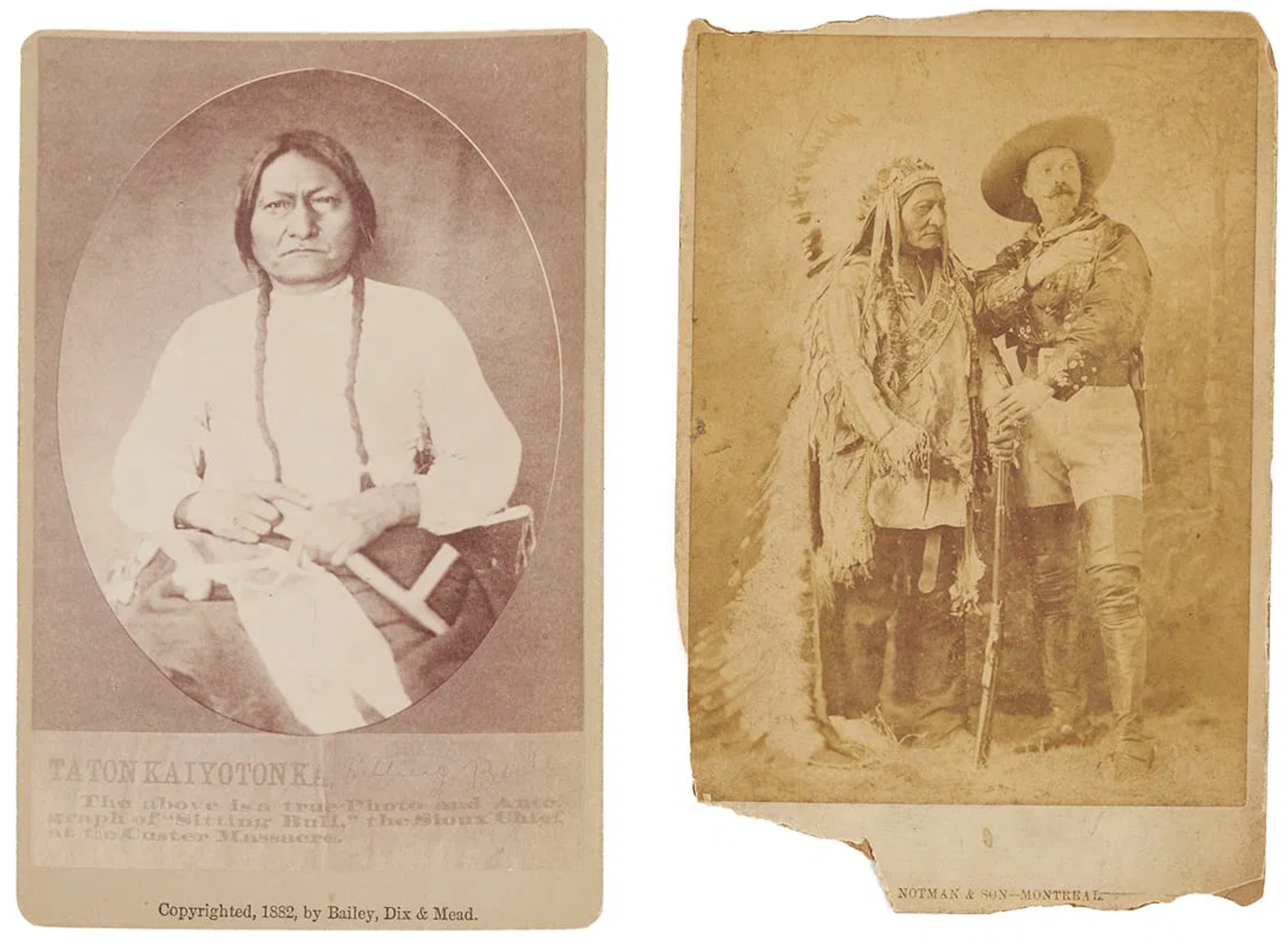
An exceptional pairing of two of the most recognizable nineteenth-century photographs of Sitting Bull—one made during his confinement at Fort Randall and the other alongside Buffalo Bill Cody during his remarkable 1885 season with Buffalo Bill’s Wild West.
Offered here as a historically compelling pair are two original-period cabinet photographs documenting radically different chapters in the life of Sitting Bull (Tatanka Iyotake), Hunkpapa Lakota leader and one of the most consequential Native American figures of the nineteenth century.
The first is the celebrated 1882 Bailey, Dix & Mead portrait, produced at Fort Randall, Dakota Territory. The second depicts Sitting Bull alongside William F. “Buffalo Bill” Cody, photographed by the renowned William Notman & Son studio in Montreal in August 1885. The Library of Congress confirms that the latter image originated during Buffalo Bill’s Wild West visit to Montreal.
Together, the photographs document Sitting Bull first as a prisoner of the United States government and, only three years later, as an internationally famous figure appearing alongside Buffalo Bill.
The 1882 Fort Randall Portrait
The first cabinet card depicts Sitting Bull seated, his long braids falling over his chest and a pipe resting across his lap.
The mount identifies him as “TATON KAIYOTONKA” and bears the copyright:
“Copyrighted, 1882, by Bailey, Dix & Mead.”
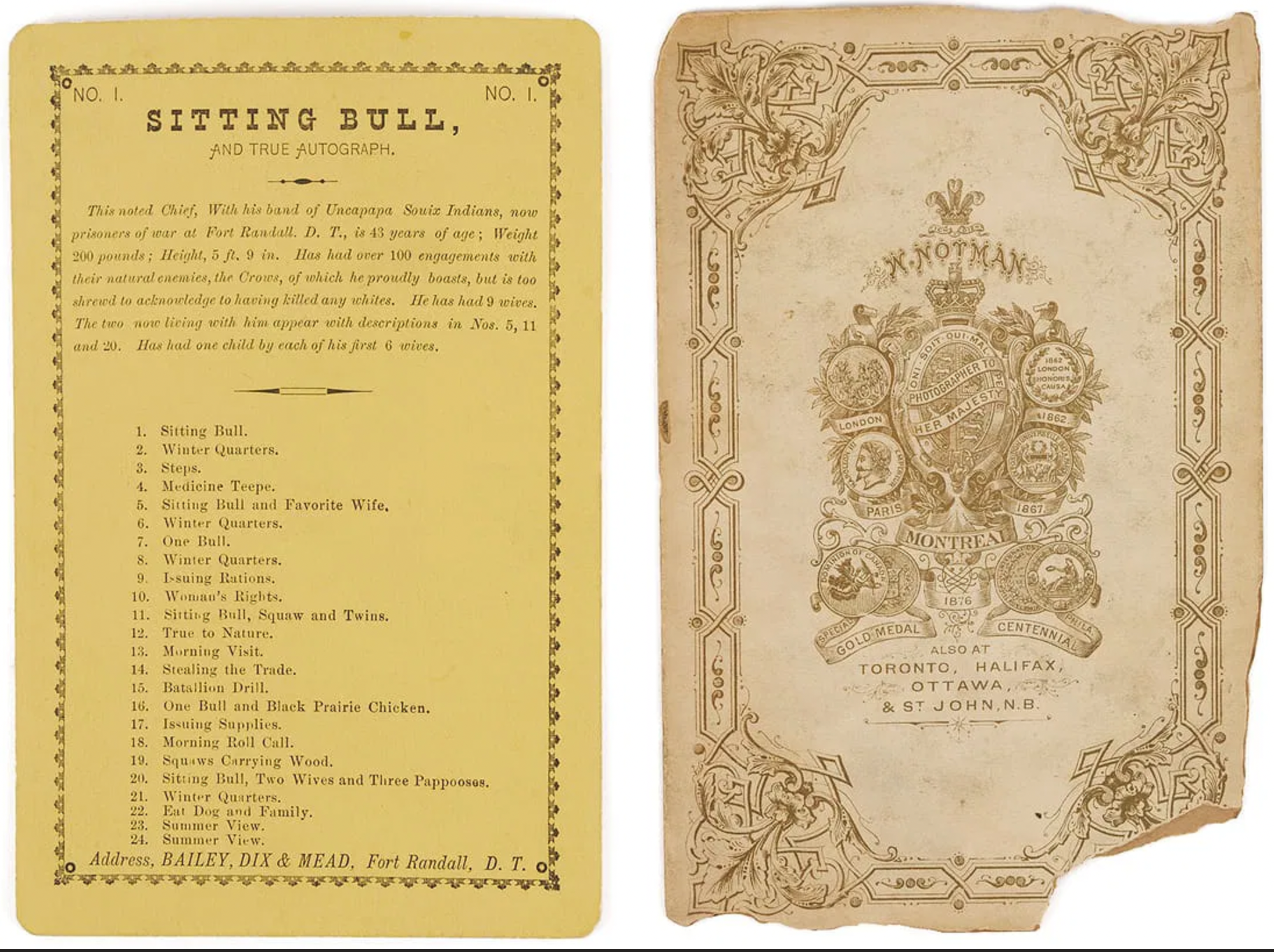
This is a documented period cabinet-card issue published by Bailey, Dix & Mead of Fort Randall, Dakota Territory. The University of Michigan identifies the format as an albumen photograph on a cabinet-card mount measuring approximately 16.5 × 11 cm.
The portrait dates from an extraordinary period in Sitting Bull’s life. After years in Canada following the Great Sioux War, he returned to the United States in 1881 and was held as a prisoner of war at Fort Randall before eventually being transferred to Standing Rock.
Important collector note: the signature associated with the printed caption on these Bailey, Dix & Mead cards is a facsimile incorporated into the photographic issue, not an individually handwritten Sitting Bull autograph. Heritage specifically documents this characteristic of the 1882 issue.
Sitting Bull and Buffalo Bill — Montreal, 1885
The second photograph presents one of the extraordinary visual pairings of the American West: Sitting Bull standing beside William F. “Buffalo Bill” Cody.
The mount bears the imprint: NOTMAN & SON — MONTREAL
William Notman & Son photographed Sitting Bull and Cody during Buffalo Bill’s Wild West engagement in Montreal in August 1885. The original Notman negative survives in the collection of the McCord Stewart Museum, and the Library of Congress also preserves an example of the image.
The photograph has often been associated with the idea of “Enemies in ’76, Friends in ’85”—a remarkable transformation occurring less than a decade after the Battle of the Little Bighorn.
Sitting Bull joined Buffalo Bill’s Wild West for a single season in 1885. The Notman studio session produced a series of portraits of Sitting Bull alone and together with Cody. The Art Canada Institute notes that the Montreal session occurred while the Wild West was touring and describes the double portrait with the two men posed together over a rifle.
Two Chapters of a Remarkable Life
Presented together, these photographs possess considerably greater narrative power than either image alone.
1882: Sitting Bull is photographed at Fort Randall while a prisoner of war.
1885: Sitting Bull stands beside Buffalo Bill Cody as one of the most famous participants in the Wild West spectacle.
Within three years, the United States had transformed Sitting Bull in the public imagination from feared adversary to internationally recognized celebrity—while he remained a powerful symbol of Lakota resistance and survival.
Condition
The 1882 Bailey, Dix & Mead cabinet card presents particularly well, retaining strong image detail and its original printed identification and copyright information. Expected age toning and minor handling characteristics are present.
The 1885 Notman & Son cabinet photograph exhibits substantially greater age and condition wear, including fading, toning, edge wear, corner losses and deterioration to the mount, particularly along the lower edge. Nevertheless, the important central image of Sitting Bull and Buffalo Bill remains readily visible and historically evocative.
The condition has been preserved rather than cosmetically altered, retaining the character of two photographs that have survived for approximately 140 years.
Please examine all accompanying photographs carefully, as they form an integral part of the condition description.
Details
Subjects: Sitting Bull (Tatanka Iyotake) and William F. “Buffalo Bill” Cody
Photographers/Publishers: Bailey, Dix & Mead; William Notman & Son
Dates: 1882 and 1885
Locations: Fort Randall, Dakota Territory; Montreal, Quebec
Format: Cabinet photographs
1882 image: Sitting Bull seated with pipe
1885 image: Sitting Bull with Buffalo Bill Cody
Category: Native American History / American West / Photography / Buffalo Bill / Lakota History
Collector Significance
This pairing offers something more substantial than two vintage photographs.
It presents two defining moments in Sitting Bull’s extraordinary final decade, separated by only three years: the imprisoned Lakota leader at Fort Randall and the internationally recognized Sitting Bull standing alongside Buffalo Bill Cody.
Both images are documented institutional holdings and recognized examples of nineteenth-century Western photography. The combination creates an unusually effective visual record of one of the most complicated transformations in the history of the American West.
A compelling pair of original-period cabinet photographs documenting Sitting Bull at the intersection of Lakota history, American expansion, photography, and the mythology of the Old West.